
On this page
Dr. Chrysoula I. Liakou MD, PhD


- Treated online: Yes, usually. Mild to moderate acne is assessed from clear photos plus video and treated with prescription creams and, where needed, tablets; deep painful nodules, abscesses with fever or suspected scarring need in-person care.
- What it is: blocked and inflamed pores (hair follicles with their oil glands), driven by excess oil, dead skin cells, the skin bacterium C. acnes and hormones; it affects about 85% of people between 12 and 24 and about 1 in 4 adults.
- Timelines: most acne treatments take 6 to 12 weeks to show their full effect, with a review at about 3 months; skin often looks unchanged, or briefly worse, in the first weeks.
- Myths: acne is not caused by poor hygiene or chocolate, and aggressive scrubbing usually makes inflamed skin worse; high-glycaemic diets and some dairy may worsen it in some people.
- Scarring: squeezing spots pushes inflammation deeper and is the most preventable cause of acne scarring; early treatment of inflamed acne is the best scar prevention.
- Emergency: there is no acne emergency; the only 112 situation is a serious allergic reaction to an acne medicine, with lip or throat swelling, wheeze or faintness.
Online care suits mild to moderate acne. Painful deep nodules or abscesses with fever, sudden severe acne with joint pain, or suspected drug-induced acne need physical examination. See the referral criteria below before booking.
Can an online doctor treat acne?
Often, yes. Clear photographs and a video consultation can provide enough information to assess mild to moderate acne, and the doctor can then prescribe guideline-based treatments such as topical retinoids, benzoyl peroxide combinations or time-limited antibiotic courses.[1][5] Diagnostic uncertainty, deep or nodular lesions and suspected scarring may require in-person examination. The doctor tells you plainly which side of that line you are on.
For acne that has not settled with pharmacy products, you can also start with an Express Assessment for acne: a short online questionnaire that a licensed doctor reviews. If the doctor needs to speak to you, the video call is included.
Listen: Acne Treatment Online
The audio version of this topic from the Mobi Doctor podcast. Open the episode.
How an online consultation helps with acne
- Severity grading from photos: the doctor counts what dermatologists count (blackheads and whiteheads, inflamed spots, deeper nodules) and grades your acne as mild, moderate or severe. That grade, plus your scarring risk, steers the treatment.
- Prescriptions after a real consultation: a prescription is never issued without a consultation. If assessment supports it, prescription-strength treatment goes beyond pharmacy shelves that you can use at a pharmacy near you.
- A plan with a review date: acne treatment is judged over weeks, not days. You leave with a plan, a date to review it, and instructions on what to stop using in the meantime.
- Honest referral when it matters: if your acne needs specialist assessment (deep nodules, scarring, failed treatment courses), the doctor says so and writes the referral instead of selling you another cream.
📷 Before your appointment: take two or three photos in daylight with no make-up: whole face at arm’s length, a close-up of the worst area, and your chest or back if affected. Sharp, well-lit photos let the doctor distinguish blocked pores from inflamed spots and nodules, which is exactly the distinction the treatment choice hangs on.
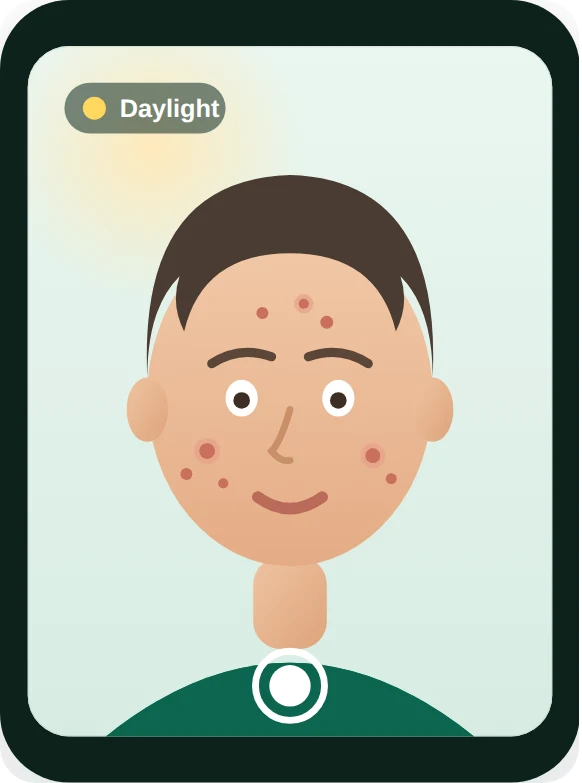 1 · Whole face
arm’s length · daylight · no make-up
1 · Whole face
arm’s length · daylight · no make-up
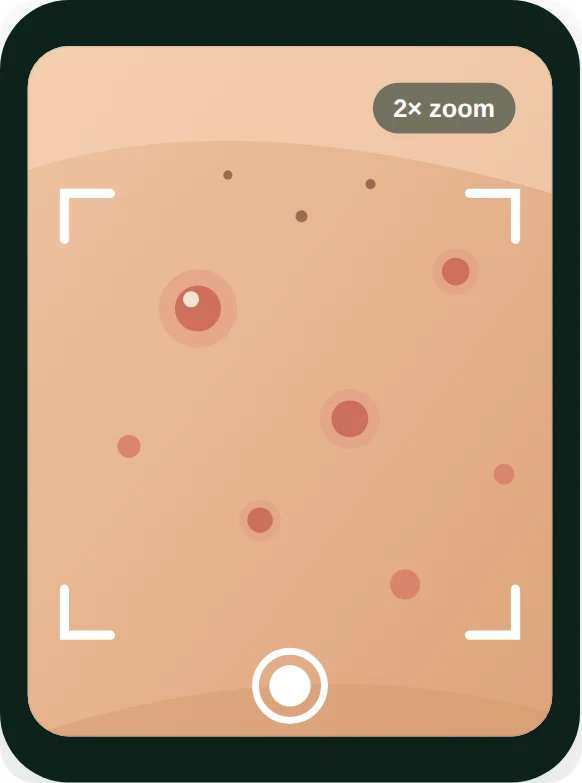 2 · Close-up
the worst area, in sharp focus
2 · Close-up
the worst area, in sharp focus
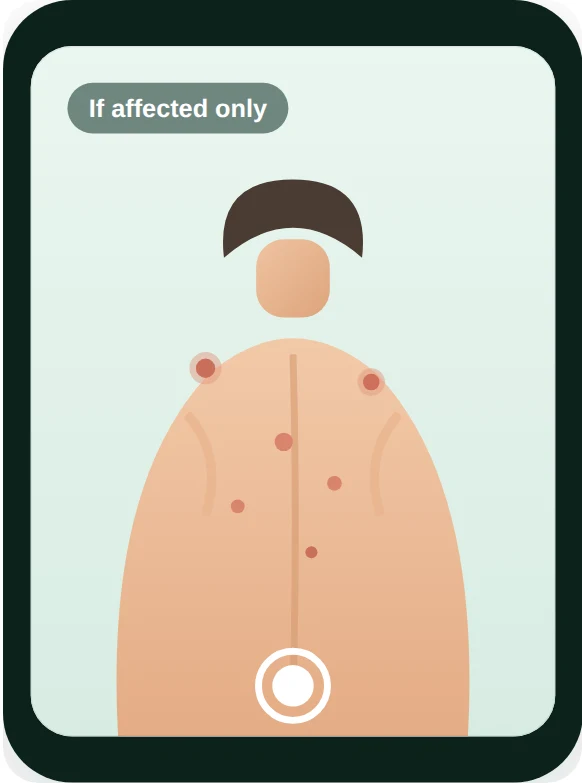 3 · Chest or back
only if affected
3 · Chest or back
only if affected
How to photograph your acne before a consultation. Reviewed 5 August 2026.
What the doctor checks in an online acne consultation
The assessment is structured, not a glance at a photo. In an acne consultation, the doctor will typically assess:
- Lesion types and count: comedones (blocked pores), inflamed papules and pustules, and any deeper nodules or cysts, across face, chest and back.
- Severity grade and scarring risk: including early scarring or pigment changes, which move treatment up a step.[1]
- How long, and what you have tried: duration, previous prescription and pharmacy treatments, how long each was used, and what happened.
- Hormonal pattern: flares linked to the menstrual cycle, and features that suggest polycystic ovary syndrome, which changes the work-up.
- Triggers and medicines: drugs that can provoke acne (some steroids, lithium, certain contraceptives), occlusive cosmetics, and habits like aggressive scrubbing.
- Pregnancy status and plans: because several first-line acne treatments must not be used in pregnancy.[1][2]
- Impact on you: acne’s effect on mood and confidence is a treatment consideration in its own right, not an afterthought.
What causes acne?
Acne forms when hormones increase the skin’s oil production, dead skin cells block the pore opening, and a normal skin bacterium, Cutibacterium acnes, multiplies in the trapped oil and triggers inflammation.[3] The result ranges from blackheads and whiteheads to red spots and deeper nodules on the face, chest and back. It is not caused by poor hygiene, and aggressive scrubbing usually makes inflamed skin worse. Adult acne is common, particularly in women, where hormonal patterns often drive it: flares that cluster before periods, spots concentrated along the jawline and chin, or acne appearing for the first time in your late twenties or thirties. When that pattern comes with irregular cycles or excess facial hair, the doctor will also consider polycystic ovary syndrome, because treating the hormonal driver changes the plan.[3] Either way, “teenage skin” framing wrongly puts many adults off seeking treatment that works.
Two conditions are regularly mistaken for acne. If your skin shows flushing, persistent redness and visible vessels without blackheads, it may be rosacea, which needs different treatment; and uniform itchy bumps around hair follicles after shaving, sweating or hot tubs point to folliculitis rather than acne. Part of the consultation is making sure you are treating the right condition.
Which acne treatment might the doctor recommend?
Treatment follows severity. This is the decision framework the doctors use, aligned with European and UK guidance:[1][4]
Swipe sideways to compare →
| Acne presentation | Likely first step | Suitable for online care? | When referral may be needed |
|---|---|---|---|
| Mostly blackheads and whiteheads (comedonal) | Topical retinoid, or fixed-combination gel with benzoyl peroxide | Usually yes | Uncertain diagnosis, or no response after an adequate course |
| Inflamed spots (papules and pustules, mild–moderate) | Combination topical treatment; sometimes an oral antibiotic added, always paired with a topical and time-limited | Usually yes | Early scarring, rapid worsening, or failed combination courses |
| Deep nodules, cysts, or scarring | Prompt medical assessment; often a specialist pathway including isotretinoin | Initial assessment and referral, not ongoing management | Common: nodulocystic or scarring acne is a standard referral trigger[4] |
| Pregnant, breastfeeding, or trying to conceive | Pregnancy-compatible options only (e.g. azelaic acid; specific advice per case) | Case-dependent | Moderate–severe disease, or whenever treatment choice is not clearly safe |
Not sure which row is you? A doctor can tell you in one consultation.
See available times →Treatment options for acne
What you can do yourself
Wash twice daily with a gentle cleanser, choose non-comedogenic moisturisers and sunscreen, and resist squeezing, which pushes inflammation deeper and raises scarring risk. Benzoyl peroxide is available without prescription in many countries; adapalene may require a prescription depending on where you are. Either can control milder acne. Give any product several weeks before judging it.[3]
Prescription treatment after your consultation
A prescription is never issued without a consultation; after assessment, the doctor matches treatment to your grade: topical retinoids and fixed combinations for comedonal and mild inflammatory acne, and for moderate inflammatory acne, time-limited oral antibiotic courses, always combined with a topical agent and reviewed rather than repeated indefinitely.[1] For women with a clearly hormonal pattern, some combined contraceptive pills also improve acne, which the doctor can weigh up alongside suitability screening. Expect visible change over 6–12 weeks with a review at around three months.[1][4] Some options carry firm restrictions: oral tetracyclines and topical retinoids must be avoided in pregnancy,[1] and isotretinoin, the strongest option for severe acne, requires specialist assessment, structured monitoring and strict pregnancy prevention.[2]
Acne in pregnancy
Pregnancy changes the rules more than any other factor: retinoids in any form and oral tetracyclines are off the table, while options such as azelaic acid are generally considered compatible.[1] Tell the doctor if you are pregnant, breastfeeding or trying to conceive. It is one of the first questions in the consultation, and treatment is chosen around it, case by case.
Acne myths, and what actually matters
“It’s a hygiene problem.”
It isn’t. Acne starts inside the follicle, and washing more often, or harder, strips the skin without touching the cause. Twice daily with a gentle cleanser is enough.[3]
“It’s your diet.”
Mostly overstated. For some people, consistently high-glycaemic eating may aggravate acne, but the evidence against particular foods such as chocolate is weak, and restrictive diets are not a treatment. If you notice a clear personal pattern, mention it in the consultation, but nobody should be cutting food groups instead of treating their skin.[3]
“Sun clears it up.”
A tan can mask redness for a while; it does not treat acne, and it worsens the marks spots leave behind. More importantly, several acne treatments, including tetracycline antibiotics and retinoids, make skin more sun-sensitive, so daily sunscreen becomes part of the treatment, not an optional extra.[1]
“Toothpaste dries out a spot.”
It irritates far more than it dries, and irritated skin breaks out more. The same goes for most home remedies that sting.
“Make-up makes acne worse.”
Not if it is non-comedogenic and removed at night. Stress and short sleep, on the other hand, genuinely can amplify flares: they don’t cause acne, but they turn the volume up.
Protecting your skin while treatment works
The 6–12 week treatment window is where scars are prevented or made. Scarring follows deep inflammation, and squeezing forces that inflammation deeper. Treating moderate acne properly and early is the single most effective scar prevention there is; established scarring is a referral conversation once the acne itself is controlled.[1]
The flat marks spots leave behind, known as post-inflammatory pigmentation, deserve their own mention, because they are often what bothers people most, particularly in darker skin tones where they run deeper and last longer. They fade, but slowly, and daily sunscreen meaningfully speeds that up. Treating the active acne first is what stops new marks forming.[3]
If you are started on a topical retinoid, expect some dryness and flaking in the first weeks. A pea-sized amount for the whole face, application on alternate nights to begin with, and moisturiser before or after all make it manageable, and most skin settles as it adapts. And between booked reviews, book again sooner if things clearly worsen: new deep painful lesions, severe irritation, or no change at all by the review date are all reasons to adjust the plan rather than push through.
When acne is treated online, and when you need in-person care
Treated online: comedonal and mild-to-moderate inflammatory acne; hormonal-pattern adult acne suitable for topical or standard oral treatment; treatment reviews and step-ups after a previous course; and restarting a plan that worked before.
In-person care: nodulocystic acne, established or progressing scarring, or acne with systemic symptoms, all standard triggers for dermatology referral;[4] suspected drug-induced acne, where the underlying prescription needs reviewing in person; moderate–severe acne in pregnancy; and acne that has failed adequate courses of combined treatment, where isotretinoin assessment is the honest next step. In those cases the consultation buys you a proper referral, not another cream. Acne is one of many skin conditions the doctors assess online. The same photo-and-video process can help doctors assess several visible skin concerns, including eczema and unexplained rashes, although some presentations require in-person examination.
When acne needs in-person care
Painful deep cysts with fever, rapidly spreading redness, or feeling systemically unwell alongside severe acne need physical examination promptly. And if you ever develop signs of a serious allergic reaction to a medication, such as swelling of the face or throat or difficulty breathing, call 112 immediately.
Treating acne at home: what helps and what does not
A consistent, gentle routine genuinely improves mild acne: a non-stripping wash twice a day, non-comedogenic moisturiser and sunscreen, not picking, and patience measured in weeks. Pharmacy products with benzoyl peroxide or adapalene are the strongest home options and a fair trial of them takes about eight to twelve weeks.
What home care cannot do: it cannot shift moderate or nodular acne, and it cannot outrun scarring. Deep painful spots, acne across chest and back, dark marks or pitting left behind, or three months of diligent home care with little to show are all signs the next step is prescription treatment, and the earlier that starts, the less there is to undo.
Staying at home is the point of Mobi Doctor: you can see a licensed doctor over video, usually within 15 minutes, with no waiting room. If medication is the right answer, the prescription follows. Book a video consultation: the exact price is shown before you pay.
How do you get rid of acne fast?
Nothing clears established acne overnight, and products promising it are the most reliable way to irritate your skin into looking worse. Real change is measured in weeks at best.
Where speed is real: prescription treatment is the fastest legitimate route to visible improvement, because it works at strengths and mechanisms shop products cannot, and starting it early is also what limits scarring. If a deadline matters, a wedding, a season, the honest move is a doctor now rather than another eight-week experiment first.
How Mobi Doctor works
- Book a time that suits you: open daily 7am–11pm CET. You can see a doctor over video, usually within 15 minutes. No subscription, exact price up front.
- Upload your skin photos, then speak to a licensed doctor: a private video call: you describe what you feel, the doctor asks what matters, and you agree the right plan together.
- Leave with your plan: everything agreed before you hang up: your plan, and a prescription to use at a pharmacy near you where medication is clinically right for you. If your doctor decides you need to be seen in person, you get a full refund.
No sign-up needed
Not sure it’s acne? Tick every symptom you have to see each condition page that mentions it. It finds the right page, not a diagnosis: a doctor gives you that on a video call.
Tap the body — an area or a point — to browse symptoms anywhere
Similar symptoms, different condition? Rosacea and Folliculitis can look like acne. Compare them, or look up any other symptom in the full symptom checker.
Frequently asked questions about acne
What is acne, and what causes it?
Acne is a skin condition in which the pores (hair follicles with their oil glands) block with oil and dead skin cells and then inflame. Four things drive it: excess oil under the influence of hormones, especially androgens; skin cells that shed abnormally and plug the pore; the skin bacterium C. acnes multiplying in the plug; and the inflammation that follows. Genes set the tendency; stress, some medicines and polycystic ovary syndrome worsen it.
What are the different types of acne spot?
Acne produces blackheads (open blocked pores, dark from oxidised oil, not dirt), whiteheads (closed blocked pores), papules (small red bumps), pustules (red spots with a white centre), nodules (large, hard, painful lumps under the skin) and cysts (deep, pus-filled lumps). Mild acne is mostly blackheads and whiteheads; moderate adds many papules and pustules; severe acne has nodules and cysts, which carry the highest scarring risk.
Can an online doctor prescribe acne treatment in Europe?
Yes, after a consultation. A prescription is never issued without one: the doctor assesses your acne from photos and history by video first, and prescribes when treatment is right for you, from topical retinoids and benzoyl peroxide to antibiotics or hormonal treatment, with the prescription sent to a pharmacy near you. Isotretinoin is specialist-prescribed and needs in-person care.
How long does acne treatment take to work?
Most acne treatments need 6 to 12 weeks to show their real effect, with a review at around three months to adjust the plan. Skin often looks unchanged, or briefly worse, in the first weeks as blocked pores clear. Stopping early is the most common reason acne treatment appears to fail, so the plan is judged in months, not days.
How do you get rid of acne fast?
There is no overnight fix for acne. The fastest reliable route is starting an effective treatment early and sticking with it for 12 weeks: a topical retinoid at night, benzoyl peroxide, a gentle wash twice a day and no squeezing. A single painful spot can be calmed within days with a spot treatment or, from a doctor, a short targeted course; a steroid injection into one cyst is an in-person option before an event.
How long does acne last?
Acne typically starts around puberty and settles in the early to mid-20s, but about 1 in 4 adults still has acne at 30 and some into their 40s, more often women. Each individual spot lasts days to weeks; nodules and cysts longer. Treatment controls acne while it is used and usually needs continuing until the tendency fades, so maintenance with a topical retinoid is common.
Does diet cause acne?
Diet does not cause acne, but it can nudge it. The best evidence points to high-glycaemic foods (sugary drinks, white bread, sweets) and, for some people, skimmed milk and whey protein worsening acne; chocolate and greasy food have never been shown to. A low-glycaemic diet modestly improves acne in trials, so it is worth trying alongside treatment rather than instead of it.
What is hormonal acne, and does it differ in adult women?
Hormonal acne is acne driven by androgen hormones, typically around the jawline, chin and neck, worse in the week before a period and often starting or persisting in adult women. It responds to the usual treatments and, after assessment, to combined hormonal contraception or anti-androgen tablets. Acne with irregular periods or excess hair growth prompts a check for polycystic ovary syndrome.
Do I need photos before the call?
Yes. Two or three clear daylight photos of your acne without make-up: the whole face, a close-up of the worst area, and chest or back if affected. Good photos give the doctor the detail needed to grade severity, count the inflamed spots and spot early scarring, which decides the treatment.
Can I get acne treatment online while pregnant?
Sometimes, depending on severity. Several standard acne treatments, including retinoids and tetracycline antibiotics, must not be used in pregnancy, while options such as azelaic acid and benzoyl peroxide are generally considered compatible. The doctor chooses case by case, and refers moderate to severe acne in pregnancy for in-person care.
Is acne contagious, and is it caused by poor hygiene?
No on both counts. Acne cannot be passed to anyone, and the bacterium involved lives on everyone's skin. Acne is not caused by dirt: blackheads are dark from oxidised oil, not grime, and washing more than twice a day or scrubbing inflames the skin and makes acne worse. A gentle cleanser twice a day and clean pillowcases are all the hygiene acne needs.
How can I prevent acne scars and new spots?
Prevent acne scars by treating inflamed acne early and never squeezing or picking, which pushes inflammation deeper. Prevent new spots by using a non-comedogenic moisturiser and sunscreen, removing make-up every night, washing after sweating, changing pillowcases often, keeping hair products off the face, and continuing maintenance treatment once the skin is clear. Persistent scarring is treated by a dermatologist once the acne is controlled.
What can an online acne assessment do, and what can it not?
Clear photographs and a video consultation can often provide enough information to assess mild to moderate acne and start guideline-based treatment. Diagnostic uncertainty, deep or nodular acne, suspected scarring, acne with fever or joint pain, and isotretinoin treatment require in-person examination, and the doctor tells you directly when that applies.
- Acne vulgaris: management (NG198), NICE, National Institute for Health and Care Excellence, 2021 (updated 2023).
- Retinoid-containing medicinal products: pregnancy-prevention measures, EMA, European Medicines Agency, 2018.
- Acne, DermNet New Zealand Trust, reviewed 2024.
- Acne vulgaris: treatment guideline, HSE, Health Service Executive (Ireland), reviewed February 2026.
- Topical benzoyl peroxide for acne (systematic review), Cochrane, Cochrane Skin Group, 2020.
- Acne, NHS, National Health Service (UK), accessed October 2026.
This page is for information only and is not a substitute for a medical consultation. Guideline links are provided for transparency; treatment decisions are made with your doctor.
Related conditions
More about acne from the Mobi Doctor blog
What Causes Forehead Acne?
Forehead acne occurs when oil, dead skin cells, or bacteria clog pores. Common triggers include hormonal changes, stress...
Read article → Health and WellbeingHow To Get Rid Of Chest Acne
How Do You Get Rid Of Chest Acne? Chest acne can be treated with regular cleansing, acne targeted skincare and avoiding...
Read article → Expert Health AdviceHow To Best Treat Acne Scars
Acne scars can be managed with at-home remedies, over-the-counter products, and medical treatments. Options include reti...
Read article →Speak to a doctor about acne over video, usually within 15 minutes
Licensed doctors · open daily 7am–11pm CET · exact price before payment
See available times →